Top 5 World History Jeopardy Games for High School Classrooms


Sometimes you just need your class to wake up. You’re halfway through the semester, the textbook chapters are blurring together, and half the room forgot what happened before the Industrial Revolution. That’s where a well-timed Jeopardy session saves the day. Not just any trivia game, but one that’s actually built around what you’ve been teaching.
Factile’s public game library is full of creative classroom content. After browsing through a wide range of history games, we pulled together five that really nail the mix of structure, variety, and classroom usefulness.
These aren’t flashy or filled with weird filler questions. They’re practical, full of useful historical content, and designed in a way that actually supports classroom learning, not distracts from it.
We’re talking structured topics like vocabulary and geography, focused games on single eras like World War I, and even AP-aligned content broken down by test periods. If you’ve got 40 minutes and a smartboard (or even just a projector), any of these can slide right into your lesson plan with barely any prep.
Let’s break down what makes each one actually worth using.
1. World History Midterm Review
Link: Play here
This one’s like the Swiss Army knife of Jeopardy sets. It doesn’t go too deep in one area, but it gives students a solid refresh across five useful categories. It’s clearly designed for a mid-semester check-in, which is exactly how it works best.
What it includes:
Dates: Events across global history, probably ranging from classical empires to modern wars
People from Places: Name where key figures originated
Location: Geography-based historical questions
People to Events: Match a historical figure to the event they’re tied to
What’s helpful here is the mix. Some categories test recall, others connect people to big moments. It’s not too obscure. The $100 and $200 tiers are especially friendly to students who just need to jog their memory before moving on to deeper discussion.
How to use it:
Split your class into teams. You’ll start seeing who remembers the big-picture stuff and who’s fuzzy on basics. That’s useful in itself.
It’s not flashy. But it works. And when you're working with 9th or 10th graders who’ve just been overloaded with chapters, a review game like this can help them breathe again.
2. History of History
Link: Play here
This one’s a bit different. Instead of a typical history breakdown, you’re getting slices of how history shows up in culture. Not just world history but American, cinematic, political, televised... and even "miscellaneous." That alone makes it feel more like a debate starter than a test-prep tool.
Categories:
- American History
- World History
- Cinematic History
- Televised History
- Political History
- Miscellaneous
What stands out? It lets you touch on how history is presented. Which can spark way more interesting conversations than just “What year was the Battle of Hastings?”
This is probably not the set you open before a quiz. But it’s the one you pull out when students ask, “Why do we have to learn this?” Use it when you're introducing historiography or trying to connect historical content to media literacy.
You could even run this on a Friday when you know attention spans are fading, and instead of playing straight, have students fact-check the answers or challenge them.
It leans slightly more advanced. Might work best in an honors class, or with a teacher walking them through unfamiliar references. But it’s a solid tool when you want something off-script that still has classroom value.
3. World War I

Link: Play here
Focused. That’s the word here. This game is built around World War I, and it’s honestly pretty well-structured. You get exactly what you need if you're covering that time period in class, no filler.
Categories:
- Leaders
- Causes
- People
- Inventions
- Random
- Long-Term Impacts
That last category, ‘long-term impacts, ' is what gives this game more weight. It’s not just facts about trenches or names of generals. It pushes students to think about what came after. How did WWI shape the next century? That’s often the kind of context students miss.
It also helps that the rest of the categories hit every core concept. Causes of the war? Covered. Famous people? There. Inventions? You’ll probably get tanks, poison gas, aircraft, and so on.
How to use it:
Run this right after finishing your WWI unit. Or break it into two sessions: one for the early categories, one for impact and aftermath. It’s flexible.
This one feels like it was built by someone who taught the unit before. It doesn't overwhelm, and it still encourages some big-picture thinking. If you only have time for one history game this semester, this could be it.
4. World History (Kaori)
Link: Play here
This one reads like a curriculum checklist, and that’s not a bad thing. If you're building a foundation in global history, it’s got a bit of everything. The kind of categories that work for review and for checking who’s following what.
Categories:
- Geography
- Vocabulary
- Religions
- Civilizations
- Government
- Periods of Time
The vocabulary category is a big help here. It’s easy to forget how often students stumble on definitions—"monarchy," "empire," "theocracy"—not because they don’t know the history, but because they don’t know the word.
Same with "Periods of Time." That category forces students to think across eras—Ancient, Classical, Post-Classical, and so on— which is vital if you're building toward comparative thinking later.
How to use it:
This is a good one to keep in your back pocket for the first few months of class. It’s low-stakes enough to use as a warm-up and broad enough to hit a range of units. You could also assign each category to a small group and let them "teach" it back before you start the game.
If you’ve got students who like structure, this one will make them feel in control again. It gives them a way to organize all the loose facts into buckets, and that’s half the battle.
5. AP World History
Link: Play here
For teachers running an AP World class, this one is probably the most plug-and-play option out there. It’s not just about facts; it’s formatted to mirror the AP period system. Which means you can use it at almost any point in the year.
Categories:
- Period 1
- Period 2
- Period 3
- Period 4
- Period 5
- Period 6
Each period includes five clues, and while we didn’t peek inside every question, the structure itself is the selling point. You don’t have to explain how it’s organized; it already aligns with what students are being tested on.
That makes it perfect for test prep. But it also works for pacing. You can start each new unit with a Jeopardy day to preview key terms and people, or close it with a round of review.
How to use it:
Let your students lead. Assign teams to each period and have them prep, defend answers, and even argue over interpretations. That’s where the AP skills really get built—arguing, connecting, reasoning.
It’s clean. It’s smart. It’s one less thing you have to build from scratch.
Closing Thoughts
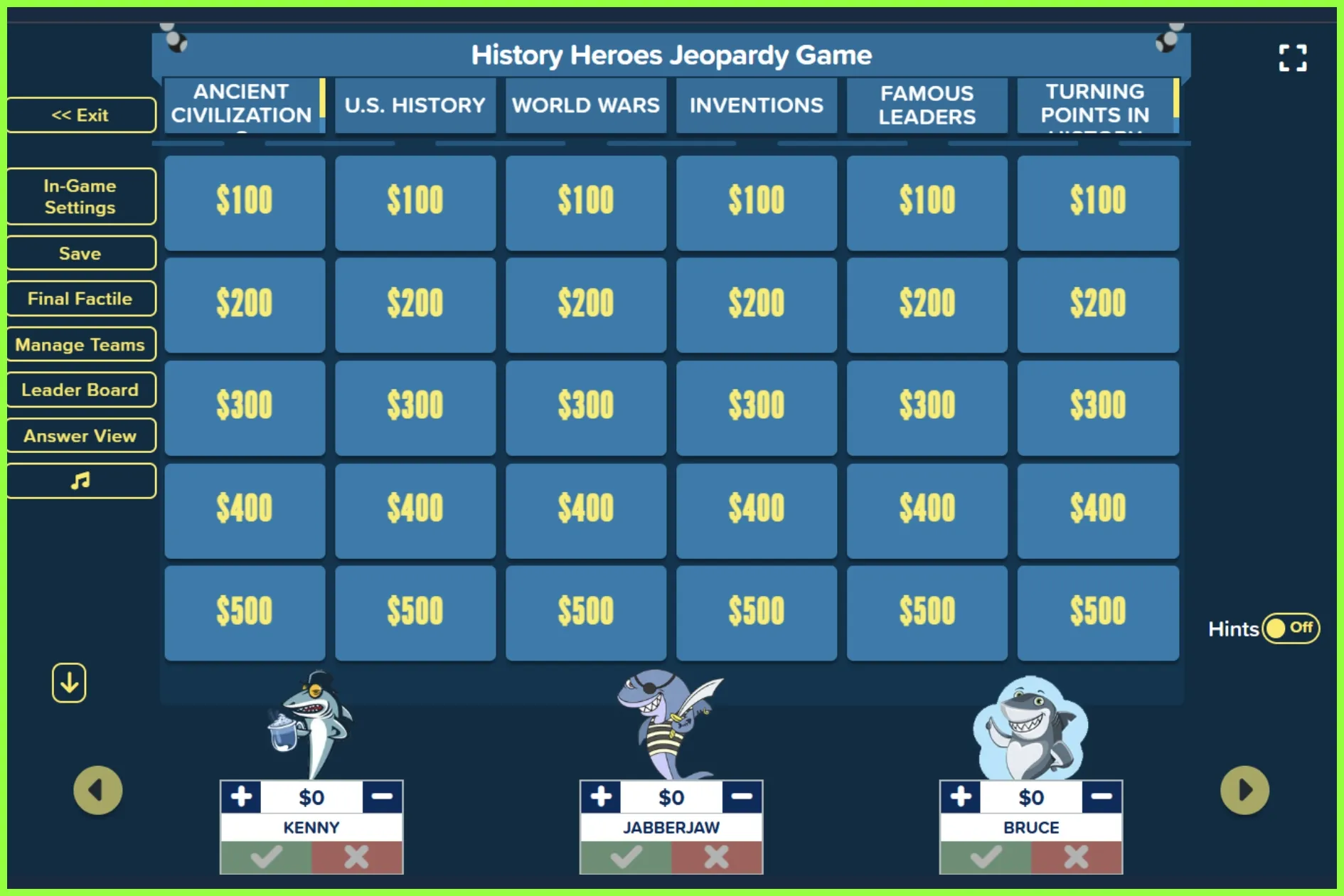
There’s no shortage of content online. But if you’re trying to make class more interactive without ditching the content that matters, these five games are a pretty strong place to start.
They don’t try to be too clever. They’re not filled with fluff or trick questions. They focus on what students actually need to review—and give teachers a break from doing all the heavy lifting.
You can copy them as-is or use them as a template to build your own. Either way, they’re a reminder that review time doesn’t have to mean another worksheet. Sometimes, a little competition is the best way to wake your class up again.
About Factile
Factile is a Jeopardy maker used by over two million teachers, instructors and trivia hosts to turn review sessions into something students really look forward to.
Instead of printing out worksheets or throwing together a quiz at the last minute, teachers can use Factile to build game boards that work in the classroom, on Zoom, or even in team-building events. You can create your first game in minutes, and yes, you can try it out completely free.
Factile is flexible enough for classroom use; e.g. maths facts, vocabulary, geography, history dates and so on. It is also handy for corporate training, live events and even family game nights. Some use it to prepare their students for tests, others to prevent meetings from becoming boring.
And the great thing is that you don’t have to be technically savvy or even creative to get started. There’s a question bank, an inbuilt buzzer mode and even an AI-powered game builder if you need help finding content quickly.
People use Factile for a variety of reasons, but most stick with it because it’s simple, it works, and it helps them save time without sacrificing fun.