
How to Play Jeopardy: Game Rules Every Player Should Know


Everyone knows Jeopardy. The dramatic music, the buzzing in, the host reading answers while contestants scramble to phrase them as questions. It’s one of the most recognizable game formats in the world.
But do you actually know the complete Jeopardy game rules?
Watching Jeopardy on TV is a different experience from actually playing. You can pick up the basics from a few episodes, but try explaining the rules when someone asks, “Do wrong answers lose points?” or “Who picks the next clue?” That confusion can derail an otherwise great game before it even gets going.
This guide breaks down how to play Jeopardy step by step, covering every core rule so that anyone—teachers, trainers, trivia hosts, or total beginners—can walk into a game fully prepared and run it smoothly every time.
How to Play Jeopardy (Step-by-Step)
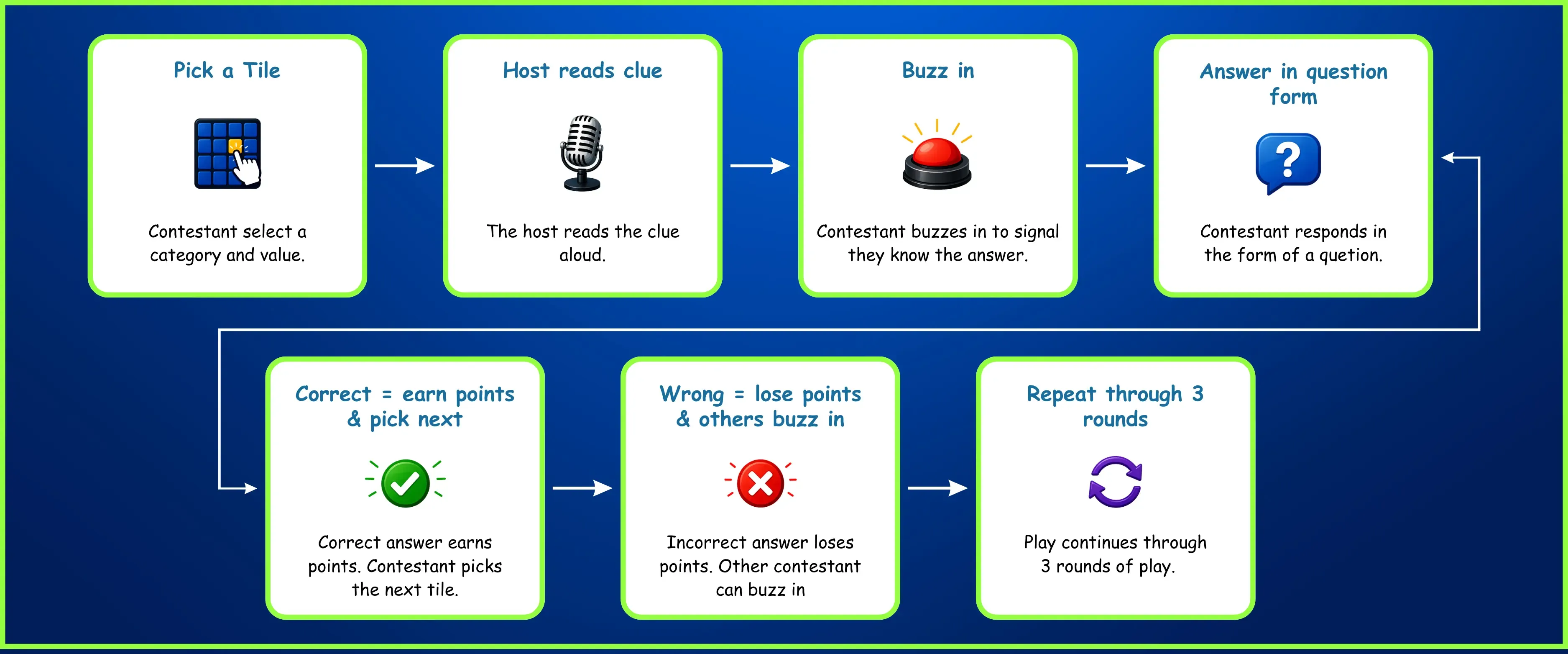
Not sure how a round actually flows? Here is the short version.
- Pick a tile: The active player chooses a category and point value from the board.
- The host reads the clue: It’s presented as a statement, not a question. That’s what makes Jeopardy, Jeopardy. For example, “These are the only two planets in our solar system that do not have moons.”
- Buzz in: Each player buzzes in when they are ready to answer.
- Player A answers in question form: “What are Mercury and Venus?” not just “Mercury and Venus.”
- Get it right, earn the points: The clue value is added to your score, and you control the next pick.
- Get it wrong, lose them: The points are deducted, and the remaining players get a chance to buzz in.
- Repeat through three rounds: Jeopardy, Double Jeopardy, and then Final Jeopardy, where wagering enters the picture.
What Makes Jeopardy Different from Every Other Trivia Game
Jeopardy may look like an ordinary trivia game at first glance, but it’s anything but. There’s a reason it’s been on the air for over four decades and is still one of the most-watched game shows in the world. A handful of unique mechanics make it unlike any other trivia format out there:
- The answers and questions are flipped: Players are given a clue phrased as a statement — the “answer” — and must respond in the form of a question. It’s the signature twist that defines the entire game.
- Players control the board: Instead of a host picking questions at random, the last player to answer correctly chooses the next category and point value. The returning champion selects first in the Jeopardy round, and the player with the lowest score selects first in Double Jeopardy. This creates real strategy — you can target your strengths, dodge your weaknesses, or hunt for Daily Doubles.
- The category grid adds risk and reward: Six categories, five clues each, with point values that increase as the difficulty goes up. Every pick is a calculated decision.
- The buzzer rewards speed — but punishes impatience: The buzzer only activates after the host finishes reading. Buzz too early and the system locks you out, handing the advantage to your opponents.
- Wrong answers cost you: Unlike most trivia games, an incorrect response deducts the full point value from your score. Scores can go negative, which means every buzz-in carries real risk.
- Wagering changes everything: Daily Doubles let players bet big mid-game, and Final Jeopardy turns the entire ending into a high-stakes gamble. No lead is ever safe.
A standard game has three rounds—Jeopardy, Double Jeopardy, and Final Jeopardy—played on a board with six categories. The TV show features three individual contestants, point values double in the second round, and the final round introduces wagering. Now let’s look at how each of these elements works in detail.
How Each Element Works
The Board
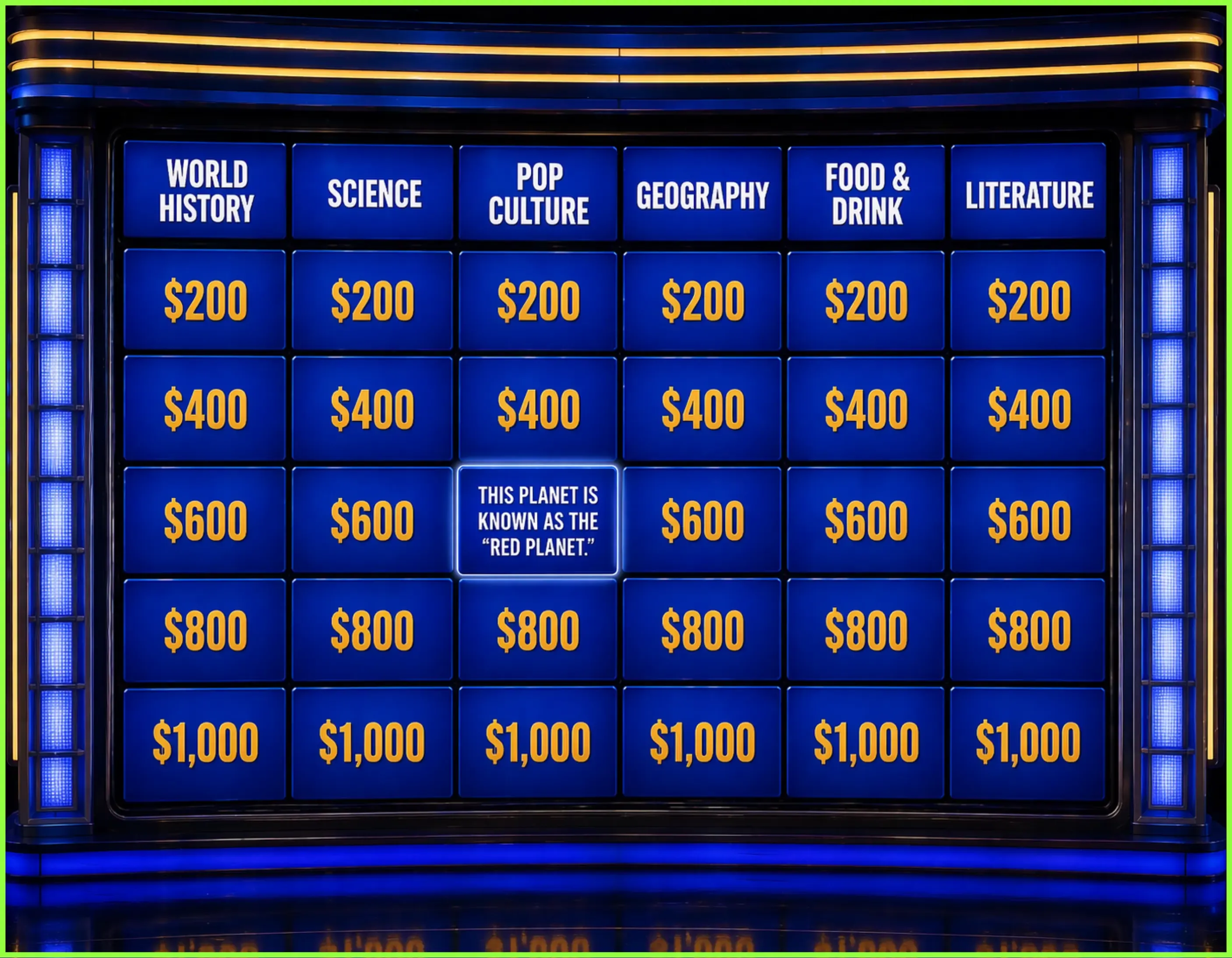
The Jeopardy board is the centerpiece of the game—a grid of six category columns, each containing five clues arranged by point value. In the first round, values typically run from $200 at the top to $1,000 at the bottom, with difficulty increasing as values go up. In Double Jeopardy, those values double.
Players select a clue by calling out a category and point value. Once a tile is selected, the clue is revealed as a statement, and the correct response must be phrased as a question.
The question-form rule is enforced differently depending on the round:
Jeopardy round (regular clues): If a contestant forgets, the host gives them a reminder and a chance to correct themselves.
Double Jeopardy, Final Jeopardy, or any Daily Double: Forgetting the question format results in an incorrect ruling—unless the contestant corrects themselves before the host rules.
In casual settings like classrooms and office events, this rule is commonly relaxed so the focus stays on fun.
The Buzzer

The buzzer gives Jeopardy its competitive edge. Once the host finishes reading a clue, the buzzer system activates, and any player can buzz in. The first one to hit the buzzer gets to respond.
- Correct answer: The points are added to that player’s score, and they choose the next clue.
- Incorrect answer: That point value is deducted from their score, and the clue opens up for the remaining players to buzz in.
- No one answers: The clue is dismissed with no score changes, and the player who originally selected it chooses the next one.
Patience pays off with the buzzer. The moment a player buzzes in, they must answer with whatever information they’ve heard. Waiting until the full clue is read gives you the best shot at a confident, correct response.
Scoring
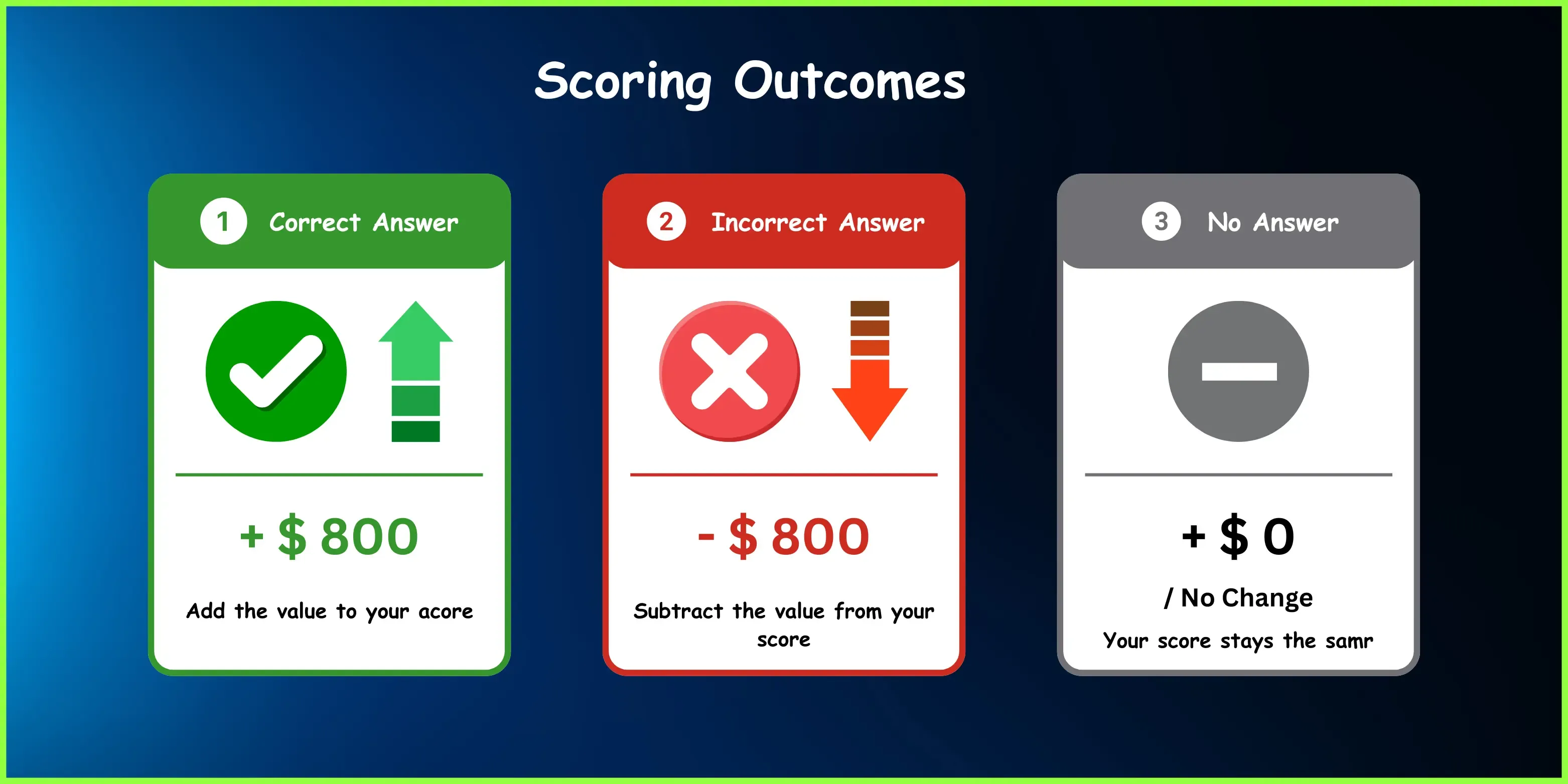
- Correct answer: Adds the clue’s point value to your total.
- Incorrect answer: Deducts the full point value from your score.
- No answer: No scores change, and the game moves on.
Scores update in real time, so every player always knows where they stand. That tension grows in Double Jeopardy, where every point value on the board doubles—and the wagering in Daily Doubles and Final Jeopardy can tip the game in any player’s favor in an instant.
Special Rules: Daily Double & Final Jeopardy
The Daily Double and Final Jeopardy are two moments where standard rules take a back seat and wagering takes over. A comfortable lead means nothing when these come into play.
Daily Double
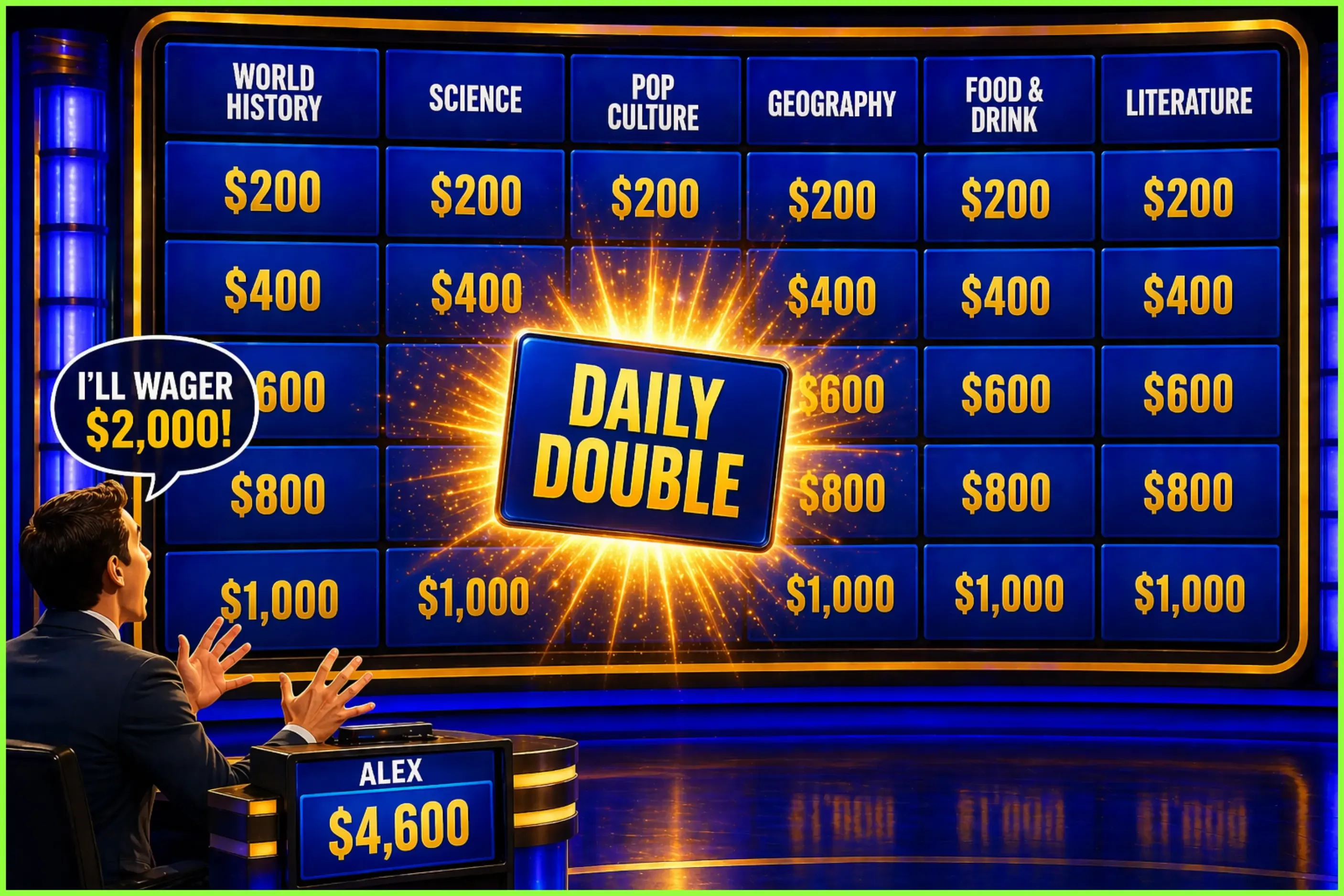
The Daily Double is a hidden tile on the board. Players don’t know which tile it is until they select it. Unlike regular clues, only the player who selected a Daily Double can respond—no other player can buzz in.
Before the clue is revealed, the selecting player must declare a wager. Key rules:
- Minimum wager: $5 in either round.
- Maximum wager in the Jeopardy round: The greater of the player’s current score or $1,000.
- Maximum wager in Double Jeopardy: The greater of the player’s current score or $2,000.
- A “true Daily Double” is when a player wagers their entire score.
At $0 or below? A player who lands on a Daily Double with $0 or a negative score can still wager up to the round’s maximum clue value ($1,000 or $2,000).
A correct answer adds the wagered amount; an incorrect answer deducts it. There is one Daily Double in the first round and two in the Double Jeopardy round. Scores can go negative from a wrong Daily Double wager, which is why knowing when to bet big and when to play it safe is just as important as knowing the answer.
Final Jeopardy
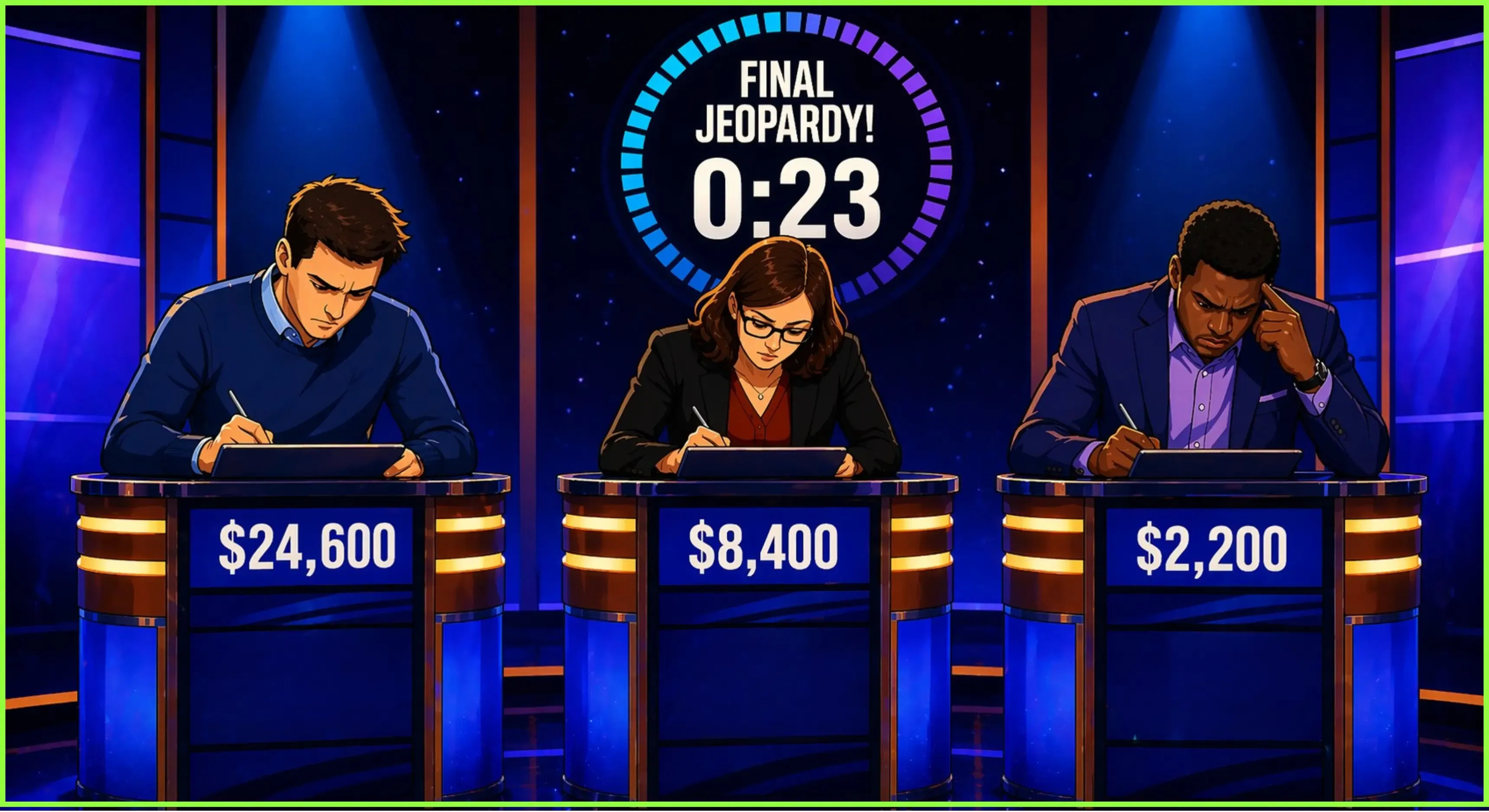
Final Jeopardy is the last round and the most dramatic. Only players who finish Double Jeopardy with a score above $0 get to participate—anyone at zero or below is eliminated. There is no buzzer involved. It comes down to one clue and one wager.
Before the clue is revealed, the category is announced and every player privately writes down their wager (from $0 up to their total accumulated score). Once wagers are set, the clue is revealed and players have 30 seconds to write their response. Then, one by one, answers come out and scores shift accordingly.
No lead is ever truly safe. A player in last place can still pull off a win with the right answer and a smart wager, while the leader can hand it all back with one wrong response. Written responses in Final Jeopardy do not need to be spelled correctly—they just need to be phonetically correct, without adding or removing any sounds or syllables.
Tiebreaker Rules

Ties in Jeopardy are rare, but they do happen. When they do, a single tiebreaker clue settles the game.
It works like sudden death: the tied players race to buzz in on one final clue, and whoever answers correctly first takes the game. If no one answers correctly, another clue is given until someone does. In casual settings, moderators often get creative—a best-of-three format or a fun bonus round can make the finish feel more earned.
Lesser-Known Jeopardy Rules
The TV version of Jeopardy includes a few smaller rules that help keep the game fair, fast-paced, and consistent:
Players cannot buzz in until the clue is fully read: The buzzer system only activates once the host finishes reading. Buzzing too early briefly locks the player out, giving other contestants a chance to buzz in first.
Contestants must answer quickly: Once a player buzzes in, they have about five seconds to begin their response. Hesitate too long, and the host moves on.
Players can sometimes correct themselves: If a contestant misspeaks but immediately corrects themselves before the host rules, judges may still accept the corrected answer.
Judges may ask for a more specific answer: If a response is too vague or could refer to multiple possibilities, the host may ask the contestant to be more specific.
If everyone finishes at $0 or below, nobody wins: Final Jeopardy is not played, no one takes home any winnings, and three new contestants appear on the next episode.
Ready to Take Jeopardy Beyond the TV?
Now you know the rules that power every game of Jeopardy—from the buzzer mechanics to the wagering strategy that makes Final Jeopardy so dramatic.
But here’s the thing: when you take Jeopardy out of the TV studio and into a classroom, an office, or a trivia night, the rules need to flex. In our next post, we cover exactly how to adapt these rules for different settings—and how platforms like Factile make those adjustments easy.