Top 5 Math Jeopardy Games for Elementary Grades


Some days, the review just falls flat. You know the type where the worksheet gets handed out, half the class zones out, and you're left wondering if anything actually stuck. When it comes to math, repetition matters, but how you get there makes all the difference.
That’s why Jeopardy-style games have stuck around. When done well, they blend structure with fun, letting students flex their math muscles without even realizing they’re reviewing. And unlike some of the more cluttered templates out there, these five public elementary math Jeopardy games on Factile are clear, content-rich, and genuinely helpful.
They cover what students in grades 2 through 5 actually need: addition, subtraction, place value, perimeter, multiplication, and decimals. These games aren’t trying to be fancy. They just work, and they fit into a real school day without much setup.
Let’s walk through five that are worth your prep time.
Why Jeopardy Works for Math Review
There’s a reason so many teachers fall back on Jeopardy-style formats. It works. Students get exposed to repetition without the monotony. They have to think quickly, explain their reasoning, and work together. That alone can help reinforce what you've been teaching for weeks.
It also adapts. You can assign point levels based on your students' comfort zones. You can keep it quiet or turn it into a loud group game. And because it’s built on questions and recall, it pushes students to retrieve knowledge, not just recognize it.
If you’ve got quiet students, this format often gives them a way to contribute without having to speak in front of everyone. Or if your class loves competition, turn it up with teams, timers, or prizes.
It’s not magic, but it works. And when you find a math review jeopardy game that’s actually aligned with your scope and sequence? That’s gold.
Game 1 – MATH MATH MATH
Play here Target Grade: 2nd–4th
Categories:
- Addition
- Subtraction
- Multiplication
- Division
- Place Value
- Decimals
What makes it useful
This one feels like the base model every teacher wishes they had. There’s nothing wild about the layout, and that’s kind of the point. It covers the six categories most teachers return to again and again.
The questions start out easy enough for a second grader, but ramp up just enough to challenge a fourth grader. The $500 questions won’t stump everyone, but they do make students pause and check their work, and that’s the kind of thinking you want.
Place value and decimals sit quietly in the bottom rows, which gives you a way to nudge students toward less comfortable territory without making it obvious. It’s a structure with a side of strategy.
How to use it in class
Use it as a warm-up in the week leading to a unit test, or turn it into a Friday station. Students can rotate in groups, each trying a different category.
Or, if you want something different for homework: assign students to come up with their own $100 and $200 questions for one of the categories. You’ll be surprised at how thoughtful they can get.
This one checks boxes for elementary math jeopardy, math review game for 3rd grade, and even place value jeopardy game. It just gets the job done.
Game 2 – Math Math Math (Greene)
Play here Target Grade: 3rd–5th
Categories:
- Addition
- Subtraction
- Multiplication
- Division
- Place Value
- Perimeter
Why this game stands out
This game brings in a little more depth. It still covers the usual four operations, but it adds perimeter to the mix, a detail a lot of teachers will appreciate.
That inclusion matters. Perimeter questions require students to apply formulas and understand spatial reasoning, not just plug numbers in. And because the layout doesn’t feel too heavy, students aren’t overwhelmed by it.
It leans slightly older—best for upper elementary or students who’ve been introduced to geometry concepts. You could absolutely use this before state testing or a major math benchmark.
How to use it in class
Hand out whiteboards and turn this into a team-based challenge. Each team has to explain their reasoning before locking in an answer.
You can also assign each group a category to "study" first, then quiz each other Jeopardy-style.
This set hits the mark for perimeter math jeopardy, math jeopardy for 4th grade, and grade 4 math review jeopardy. It’s structured, but it lets students do the thinking.
Game 3 – J and C’s Math Jeopardy
Play here Target Grade: 3rd–5th
Categories:
- Addition
- Subtraction
- Multiplication
- Division
- Place Value
- Decimals
Why it’s a solid choice
This game offers more than just variety. It delivers solid repetition across the basics, but it also introduces decimals in a clear way.
There’s something about the way this one is structured that makes it easy to use more than once. You could run a different category each day of the week. Or circle back to it every few weeks and track student growth across attempts.
It also works well as a gap filler. If you have 15 minutes to kill or your lesson wrapped early, open this up and let students compete in pairs.
How to use it in class
Turn it into a bell-ringer challenge. Let the class pick one category, then play a quick $100–$300 round. Or use it as a sub plan—simple, visual, easy to manage.
Ask students to write their own $500 question based on whatever unit you just finished. You’ll learn fast who’s ready for more.
It’s a reliable fractions decimals math jeopardy and fits the bill for elementary math jeopardy review and math game for classroom practice.
Game 4 – MATH MATH MATH COP
Play here Target Grade: 2nd–3rd
Categories:
- Addition
- Subtraction
- Multiplication
- Division
- Place Value
- Decimals
What’s unique about it
There’s something refreshingly straightforward about this one. The question language is simpler, making it easier for younger students to access without much explanation.
It follows the same structure as the other games, but it feels more approachable—and that’s useful when you're working with developing learners or ESL students.
It’s also one of the better games for reinforcing decimals in lower grades without making it intimidating. You can easily adapt the decimal questions to fit whole numbers if needed.
How to use it in class
Try a peer quiz format: have students work in pairs and ask each other questions from selected categories.
Want a theme day? Focus entirely on decimals and use this game as the central activity, followed by a quick practice sheet or group activity with base-ten blocks.
This one is a great fit for fun math jeopardy game, math review for 3rd grade, and place value math game in younger grades.
Game 5 – Bankston’s MATH MATH MATH MATH
Play here Target Grade: 4th–5th
Categories:
- Addition
- Subtraction
- Multiplication
- Division
- Place Value
- Perimeter
Why teachers like this one
This game steps it up. The top-tier ($400–$500) questions push students to apply logic, use multiple steps, and explain their work.
It doesn’t shy away from rigor, which makes it a smart option for standardized test prep or end-of-unit review.
By combining basic operations with geometry concepts like perimeter, it touches multiple parts of your curriculum in one activity. And it encourages higher-order thinking without losing students in complexity.
How to use it in class
Use it on a Friday review day or right before testing. Assign teams, and let each group specialize in a category—then compete.
Or add a twist: give students 30 seconds to solve $500 problems and see how many can explain their process out loud.
Perfect fit for grade 5 math jeopardy, perimeter review game, and a general math jeopardy game elementary teachers can rely on.
Final Thoughts + Where to Find More Games
If you’re looking for a no-fuss way to make math review days more effective, these five games are a solid place to start. Each one is editable, easy to launch, and built with real classroom structure in mind.
You can stick with the original questions or customize them based on what your students need. Either way, they save time and still make space for deeper thinking.
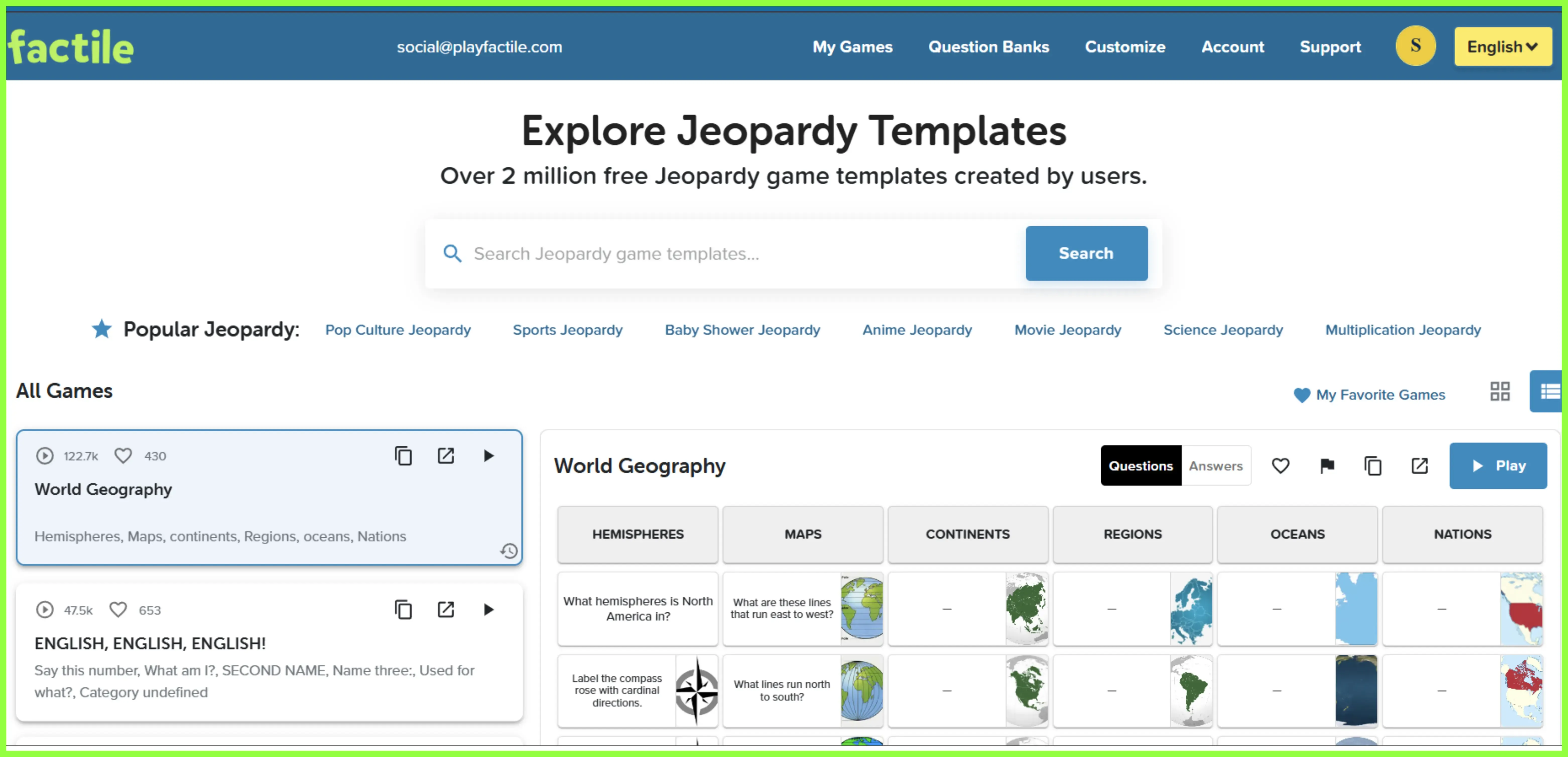
All of them are live on Factile, ready to play. You can explore even more in the library or build your own using the custom math jeopardy template tools.
It’s not about reinventing your lessons. It’s about finding simple things that work, and keep working. Jeopardy just happens to be one of them.